

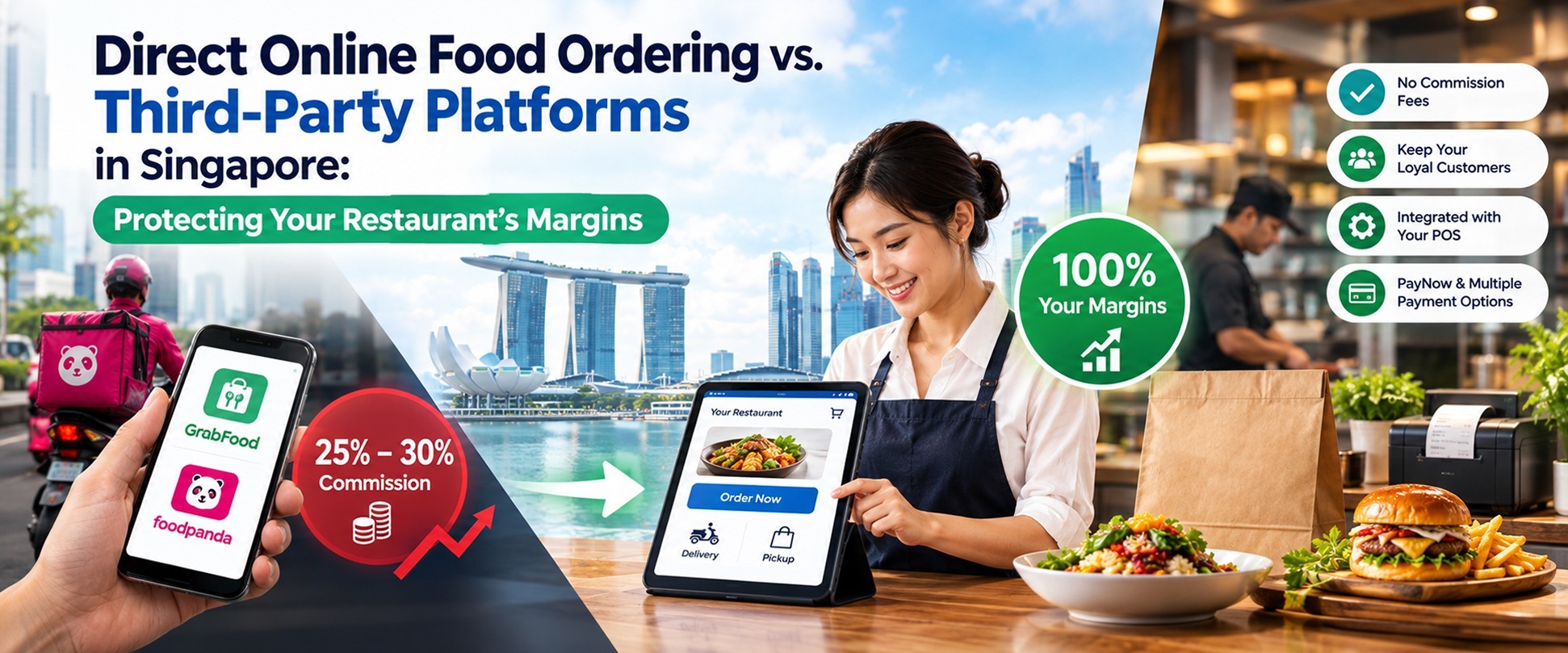
For independent restaurant and cafe owners in Singapore, food delivery is both a lifesaver and a profit trap.
On a rainy Tuesday evening in Novena or a Friday lunchtime in Tanjong Pagar, delivery riders stream through your front door. The kitchen is humming, the packaging counter is packed with takeaway bags, and gross sales look impressive on paper.
Yet, when the monthly platform payout statement arrives, the financial reality sets in:
- S$20,000 in gross delivery orders yields barely S$14,000 in net payouts.
- Third-party merchant commission fees have consumed S$5,000 to S$6,000 off your top line.
- After deducting food ingredient costs, disposable packaging, gas, and kitchen staff wages, your actual net profit on delivery is razor-thin—or negative.
Following Deliveroo’s exit from the Singapore market on March 4, 2026 the local food delivery landscape consolidated into a concentrated duopoly dominated by GrabFood and Foodpanda. With fewer competing platforms and no statutory commission caps , Singapore F&B operators can no longer afford to treat delivery as an afterthought.
To survive and thrive, food businesses must build a hybrid delivery strategy: leveraging third-party aggregators for first-time customer acquisition, while actively channeling loyal repeat diners into their own commission-free direct online ordering system [Claim ID: C-005].
Here is an operational and financial guide on how direct online ordering works in Singapore, how the unit economics compare, and how to protect your profit margins.
1. The True Economics of Third-Party Delivery Platforms
The single most common financial mistake F&B founders make is treating platform commission as a minor operational expense.
In Singapore, major delivery platforms charge merchant commissions typically ranging between 25% and 30% of gross order value [Claim ID: C-001]. Crucially, this commission is deducted from your top-line revenue, not your net profit.
[The Financial Reality of a S$50 Delivery Order – Illustrative Example]
Third-Party Aggregator (28% Commission Cut):
Gross Order: S$ 50.00
– Platform Commission (28%): -S$ 14.00
– Food Cost (COGS ~32%): -S$ 16.00
– Packaging Cost: -S$ 2.00
– Payment / Admin Fees: -S$ 1.50
————————————————
REMAINING OPERATING MARGIN: S$ 16.50 (To cover rent, labor & profit)
Direct Online Ordering Channel (0% Commission Cut):
Gross Order: S$ 50.00
– Platform Commission (0%): S$ 0.00 [Claim ID: C-005]
– Food Cost (COGS ~32%): -S$ 16.00
– Packaging Cost: -S$ 2.00
– Payment Fee (PayNow/Card): -S$ 0.75
————————————————
REMAINING OPERATING MARGIN: S$ 31.25 (Nearly DOUBLE the retained margin!)
On an identical S$50 order of pasta and drinks, direct ordering preserves S$31.25 in gross operating margin compared to S$16.50 through an aggregator. Over fifty orders a week, that difference represents thousands of dollars in retained cash flow every month.
2. What Changed After Deliveroo Exited Singapore in 2026? [Claim ID: C-002]
Deliveroo officially ceased Singapore operations on March 4, 2026, concluding an 11-year run as part of a global restructuring by its parent company [Claim ID: C-002].
This departure reshaped the local F&B market in two major ways:
- Market Power Concentration: Diners consolidated onto GrabFood and Foodpanda. With one fewer major platform competing for riders and restaurants, merchants have virtually zero bargaining power to negotiate lower commission rates.
- Regulatory Stance In an April 2026 written parliamentary reply, the authorities confirmed that the Competition and Consumer Commission of Singapore (CCCS) is monitoring the market and has not observed systematic fee spikes following the exit. However, there is no government legislation capping merchant commission rates
The takeaway for restaurateurs is clear: government intervention will not lower commission rates for you. You must take control of your own delivery economics.
3. The Balanced Approach: The “Acquisition vs. Retention” Strategy
Running your own direct ordering channel does not mean deleting your GrabFood or Foodpanda merchant accounts tomorrow.
Third-party marketplace apps excel at one specific function: cold customer discovery. Millions of hungry diners open those apps every evening without knowing what they want to eat. You pay that 25%–30% commission as a customer acquisition cost.
However, paying 30% commission every single week on a loyal customer who already loves your food is financial leakage.
The Hybrid F&B Delivery Funnel
│
┌────────────────────────────┴────────────────────────────┐
▼ ▼
[Third-Party Marketplace Apps] [Direct Branded Website]
- Goal: Acquire new diners • Goal: Retain existing fans
- High commission (25%–30%) • Zero commission (0%)
- Audience: Browsing strangers • Audience: Loyal repeat diners
│ ▲
└───────────── Convert via Bag Insert / QR ───────────────┘
The most profitable Singapore restaurants treat aggregators as a customer acquisition engine, and use deliberate tactics to migrate those customers to direct channels for future orders:
Practical Tactics to Migrate Customers:
- The “Order Direct Next Time” Packaging Flyer: Place a professionally printed card inside every delivery bag: “Loved your meal? Next time, order directly on our website to enjoy exclusive set combos and complimentary delivery!”
- Exclusive Online Bundles: Reserve large family sharing platters, catering party sets, and seasonal weekend specials exclusively for your direct website.
- Direct Loyalty Rewards: Allow customers to accumulate digital loyalty stamps or direct order credits that can only be redeemed on your branded portal.
4. How Delivery Logistics Work Without In-House Drivers
A common myth among independent restaurant owners is: “If I set up my own ordering website, I have to hire my own delivery drivers.”
In Singapore’s compact, dense urban geography, this is completely unnecessary. Modern direct ordering relies on on-demand third-party logistics fleets [Claim ID: C-006]:
- Integrated On-Demand Fleets: Services like Lalamove, GrabExpress, and pandago operate vast networks of motorcycle and car drivers across Singapore.
- Flat Distance-Based Delivery Fees: Instead of taking a percentage cut of your food sales, these logistics providers charge a transparent, distance-based delivery fee (e.g., S$5 to S$8 depending on kilometre radius) [Claim ID: C-006].
- Passing the Fee Fairly: You can choose to pass the flat delivery fee to the customer, subsidize it for orders over S$60, or offer free delivery on orders above S$100. Because the fee is fixed, your margin improves as order basket size increases—the exact opposite of marketplace apps, where higher order values result in larger commission deductions.
5. Integrating Direct Orders with Your Kitchen POS
Another historical headache for restaurants was the “multiple tablet chaos.” Orders from direct websites arrived via email or SMS, forcing cashiers to manually re-type items into the physical POS terminal to print kitchen chits.
With a unified platform like OrderZ Restaurant Website Builder:
- Direct online orders fire directly into your OrderZ Restaurant POS terminal.
- Drink and food items automatically print at their respective bar and kitchen stations or display on your Kitchen Display System (KDS).
- Order tickets clearly state pickup times or courier dispatch slots, eliminating counter confusion during service.
- Diners checkout smoothly via integrated PayNow QR or credit cards, with automated receipts complying with Singapore’s prevailing 9% GST regulations [Claim ID: C-004].
Direct Ordering vs. Third-Party Marketplace Apps: Summary
| Feature / Metric | Third-Party Delivery Platforms | OrderZ Direct Restaurant Website |
|---|---|---|
| Sales Commission Fee | 25% – 30% of gross order value [Claim ID: C-001] | 0% Commission on Food Sales [Claim ID: C-005] |
| Customer Data Ownership | Platform retains diner emails and phone numbers | You own 100% of diner customer profiles |
| Customer Experience | Diners browse competitor food on the same app | 100% dedicated to your brand and custom domain |
| Payment Options | In-app wallets and saved cards | Direct PayNow QR and major credit/debit cards |
| Best Used For | Cold discovery and reaching new neighborhood diners | Retaining loyal regulars, office lunches & catering |
| Kitchen Sync | Separate proprietary tablet; manual re-entry | Auto-syncs directly to POS and kitchen printers |