

Choosing a POS in Singapore: Why Most Systems Fail During the Friday Night Rush
Busy Singapore restaurant staff managing customer orders using a POS system during Friday night rush.
It’s 7:00 PM on a Friday Evening…
Every restaurant owner knows this feeling.
The dining area is full. New customers are waiting at the entrance. Orders are flowing into the kitchen, servers are rushing between tables, and the cashier is processing one payment after another.
For a few hours, everything depends on one system keeping your restaurant running smoothly.
Then it happens.
Your POS freezes.
The cashier can’t process payments.
A customer wants to split the bill while another is waiting to pay using PayNow. Kitchen staff stop receiving new orders because tickets aren’t printing correctly. Someone has to shout across the restaurant to check whether an order has already been prepared.
Within minutes, a smooth dinner service turns into complete operational chaos.
Customers become frustrated.
Staff become overwhelmed.
Long queues begin forming.
Every delay means slower table turnover, missed orders, and lost revenue.
For restaurants in Singapore, where customer expectations are high and competition is fierce, these situations can cost hundreds—or even thousands—of dollars in a single evening.
Many restaurant owners search for the best POS system in Singapore, comparing long feature lists and pricing plans. But during the busiest hours of the week, features alone don’t matter.
What matters is whether your POS helps your team work faster, communicate better, and deliver a seamless dining experience when every second counts.
A modern POS system shouldn’t create bottlenecks.
It should eliminate them.
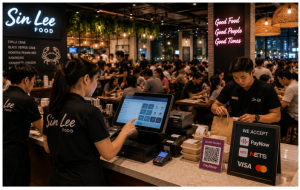
A reliable POS system Singapore restaurants choose should handle busy service periods without slowing down billing or order processing.
The Hidden Cost of Choosing the Wrong POS System in Singapore
When businesses invest in a POS system, they often assume that more features automatically mean better performance.
Unfortunately, that’s rarely the case.
Many traditional POS systems are overloaded with unnecessary menus, complicated workflows, and outdated interfaces that slow staff down during the busiest parts of the day.
Instead of simplifying restaurant operations, these systems create additional work.
Some of the most common challenges include:
- Staff having to memorize complex menu modifiers and shortcuts.
- Multiple systems for billing, online orders, kitchen management, and inventory.
- Slow performance during high order volumes.
- Complicated bill splitting for large groups.
- Delays when switching between dine-in, takeaway, and delivery orders.
- Manual communication between the cashier and the kitchen.
Individually, these issues may seem small.
Together, they create significant operational delays.
Every extra click at the billing counter increases customer waiting time.
Every manual process creates another opportunity for mistakes.
Every communication gap between the front-of-house and kitchen slows down food preparation.
During peak hours, these delays quickly add up.
Instead of serving more customers, your staff spend valuable time fixing problems that your POS should already be solving.
The result is longer queues, slower service, unhappy customers, and lower revenue.
A great POS system isn’t measured by the number of features it offers.
It’s measured by how efficiently it helps your restaurant operate when business is at its busiest.
Why POS System Singapore Restaurants Need Must Perform During Peak Hours
A Friday night dinner rush is the ultimate stress test for any restaurant management system.
During these busy periods, dozens of tasks happen simultaneously.
Customers are dining in.
Online delivery orders continue arriving.
Reservations need to be managed.
Bills need to be split.
Digital payments need to be processed instantly.
Kitchen staff need to receive accurate order information without delays.
If your POS struggles with even one of these tasks, the entire operation slows down.
A modern restaurant POS should effortlessly manage:
- Walk-in customers
- QR code ordering
- Reservations and table management
- Multiple payment methods, including PayNow and NETS
- Split billing for groups
- Kitchen Order Tickets (KOT)
- Kitchen Display System (KDS)
- Real-time inventory updates
- Instant order synchronization between the cashier, kitchen, and service staff
When every department stays connected through one intelligent system, staff spend less time fixing problems and more time serving customers.
The difference is immediately noticeable.
Orders reach the kitchen faster.
Payments are completed in seconds.
Customers receive their meals sooner.
Tables become available more quickly.
And your restaurant can serve more guests without increasing manpower.
That’s exactly what a modern cloud-based POS should deliver.
It should reduce operational complexity—not add to it.
Choosing the right POS system Singapore restaurants can rely on is important for managing busy Friday night service. A reliable system should handle billing, order processing, and payment workflows without unnecessary delays.
3 Critical Questions to Ask Before Buying a POS System
Choosing the right POS system isn’t just about comparing prices or ticking off a feature checklist. It’s about selecting a solution that supports your daily operations, helps your staff work efficiently, and scales with your business as it grows.
Before making a decision, every restaurant owner should ask these three
criticalquestions.
1. Can It Handle Peak-Hour Rushes Without Slowing Down?
Every POS system performs well when there are only a few customers.
The real test comes during peak hours.
Imagine your restaurant on a Friday evening:
- Walk-in customers continue arriving.
- Tables need to be assigned quickly.
- Bills need to be split.
- Multiple payment methods must be accepted instantly.
- The kitchen receives dozens of orders simultaneously.
A weak POS system struggles to keep up.
Employees begin entering delivery orders manually.
Kitchen tickets are delayed.
Orders are duplicated or missed.
Customers wait longer than expected.
Eventually, the entire restaurant slows down.
A modern POS should eliminate these bottlenecks by automating routine tasks and ensuring every department stays connected in real time.
Look for features such as:
- Kitchen Display System (KDS)
- Automatic Kitchen Order Ticket (KOT) generation
- Real-time order synchronization
- Automatic order routing
- Fast billing and split payments
- Offline mode with automatic cloud synchronization
- Real-time inventory updates
The less manual work your staff have to perform, the faster they can serve customers.
Why It Matters
Restaurants don’t lose customers because they’re busy.
They lose customers because they can’t handle being busy.
When guests wait too long for their meals or payments, they’re less likely to return and more likely to leave negative reviews.
A POS designed for high-volume operations helps your restaurant maintain speed, accuracy, and service quality—even during the busiest hours.
2. Is It Built Specifically for Singapore Businesses?
Not every POS system is designed for the Singapore market.
Many international platforms offer generic features but lack the local integrations and workflows that Singapore restaurants rely on every day.
Your POS should support the way your business actually operates.
Payment Support
Customers expect fast and convenient payment options.
Your POS should seamlessly support:
- PayNow
- NETS
- Visa
- Mastercard
- Allin pay
- QR code payments
The faster payments are processed, the shorter your queues become.
Local Compliance
Restaurant owners shouldn’t have to worry about tax calculations or manual reporting.
A Singapore-ready POS should support:
- GST calculations
- Digital receipts
- Tax-compliant reporting
- Loyalty programmes
These features reduce administrative work while improving the customer experience.
Understanding Cashless Payments in Singapore
Cashless payments are an important part of modern restaurant operations in Singapore. Businesses should understand the available payment options and choose a POS system that supports their operational needs. The Monetary Authority of Singapore (MAS) provides information about Singapore’s payment ecosystem and payment-related initiatives, making it a useful reference for businesses exploring digital payment solutions.
Multi-Channel Ordering
Today’s customers order in many different ways.
Some dine in.
Some order directly through your website.
Others use GrabFood or foodpanda.
A modern POS should bring every order into one dashboard instead of forcing staff to manage multiple systems.
When every order automatically flows into one platform, mistakes decrease and service becomes significantly faster.

3. Can You Manage Your Restaurant From Anywhere?
Running a restaurant doesn’t mean standing behind the cashier all day.
Owners need the freedom to monitor their business even when they’re away.
Cloud-based POS systems make this possible.
Whether you’re managing one outlet or several locations, you should have complete visibility from your laptop, tablet, or smartphone.
A modern cloud POS allows you to monitor:
- Daily sales
- Revenue trends
- Floor and table management
- Inventory levels
- Order history
- Customer insights
Instead of waiting until the end of the day to review reports, you can monitor performance in real time and make better business decisions immediately.
Why Cloud-Based POS Is Becoming the New Standard
Traditional POS systems store information on a single computer inside the restaurant.
If that system crashes, valuable business data can be lost.
Cloud POS systems automatically store information securely online, allowing owners to access reports anytime, from anywhere.
Instead of reacting to problems after they happen, you gain the insights needed to prevent them before they affect your customers.
Why These Three Questions Matter
A POS system is much more than a billing tool.
It’s the technology that connects your cashier, kitchen, service staff, inventory, reporting, and customer experience into one seamless operation.
Choosing the right system means spending less time solving operational problems and more time growing your business.
When evaluating different POS providers, don’t simply ask what features they offer.
Ask how those features help your restaurant perform during its busiest hours.
Because when Friday night arrives, that’s when your POS proves whether it’s helping your business—or holding it back.
Legacy POS vs. OrderZ POS
Selecting the right POS system isn’t just about replacing your cash register—it’s about improving the way your entire restaurant operates.
Traditional POS systems were designed primarily for billing. Modern cloud POS solutions, on the other hand, connect every part of your restaurant, from order taking to kitchen communication and business reporting.
Here’s how they compare:
| Operational Challenge | Legacy POS | OrderZ POS |
| Billing | Manual billing and slower checkout | Fast digital billing with split bills and QR payments |
| Kitchen Communication | Verbal communication and printed tickets | Real-time Kitchen Order Tickets (KOT) and Kitchen Display System (KDS) |
| Order Processing | Manual entry from multiple sources | Automatic order routing from dine-in, takeaway, and delivery platforms |
| Delivery Integration | Separate tablets for each platform | Centralized management for GrabFood, foodpanda, and direct orders |
| Inventory Management | Manual stock updates | Automatic inventory tracking in real time |
| Business Reports | End-of-day manual reports | Live cloud dashboard with real-time analytics |
| Multi-Outlet Management | Separate systems for each outlet | Centralized management across multiple branches |
| Peak Hour Performance | Slows down during heavy traffic | Fast, reliable performance during busy service hours |
Instead of juggling different systems, OrderZ brings everything together in one platform, helping restaurants serve more customers with greater speed and accuracy.

Success Story: How Yoyar Bistro Improved Restaurant Operations
Every growing restaurant eventually reaches a point where manual processes begin limiting its potential.
That was the challenge faced by Yoyar Bistro.
As customer demand increased, managing orders during peak hours became more difficult. Staff had to coordinate between the cashier, kitchen, and service team while handling dine-in customers alongside online delivery orders.
The result was slower service, increased pressure on employees, and unnecessary operational delays.
After implementing OrderZ POS, the restaurant transformed the way it operated.
With features such as:
- Table QR Ordering
- Faster digital billing
- Kitchen Order Ticket (KOT) automation
- Kitchen Display System (KDS)
- Centralized order management
- Real-time reporting
their team was able to streamline everyday operations.
Instead of spending valuable time managing paperwork and manual communication, staff could focus on delivering faster service and creating a better dining experience.
The improvements included:
- Faster order processing
- Reduced waiting times
- Improved communication between front-of-house and kitchen staff
- Lower operational complexity
- Better customer satisfaction
- More efficient manpower utilization
The restaurant didn’t simply adopt new technology—it built a more efficient workflow that supported long-term growth.
Why Singapore Restaurants Are Choosing a Cloud POS System
The restaurant industry has changed dramatically over the past few years.
Customers expect faster service.
Digital payments have become the norm.
Online ordering continues to grow.
Restaurant owners now need real-time access to business information wherever they are.
Traditional POS systems struggle to meet these expectations.
Cloud-based POS solutions are quickly becoming the preferred choice because they offer flexibility, scalability, and operational efficiency.
Some of the biggest advantages include:
Secure Cloud Backups
Business data is safely stored in the cloud, reducing the risk of losing valuable information due to hardware failures.
Real-Time Business Reports
Owners can monitor sales, revenue, inventory, and staff performance at any time.
Faster Checkout Experience
Modern payment integrations reduce waiting times and improve customer satisfaction.
Better Inventory Control
Track stock movement automatically and receive alerts before items run out.
Before investing in a POS system Singapore businesses need, restaurant owners should evaluate system reliability, ease of use, and support during peak operating hours.
Final Thoughts
Choosing a POS system is one of the most important technology decisions a restaurant owner can make.
It’s no longer just about processing payments.
A modern POS connects every aspect of your restaurant—from billing and kitchen communication to inventory, reporting, customer engagement, and business growth.
The right solution helps your restaurant:
- Serve customers faster
- Improve table turnover
- Reduce operational errors
- Increase staff productivity
- Simplify daily management
- Deliver a better customer experience
- Make smarter business decisions using real-time insights
Most importantly, it allows your team to stay focused on what matters most—providing exceptional food and service.
When Friday night arrives and your restaurant is at full capacity, your POS shouldn’t become another challenge.
It should be the system that keeps everything running smoothly.
Ready to Upgrade Your Restaurant Operations?
Every minute saved during peak hours creates a better experience for your customers and a more profitable business for you.
Whether you operate a café, restaurant, food court outlet, or multi-location F&B business, choosing the right POS system can transform the way you work.
With OrderZ POS, you get:
- ✔ Fast and reliable billing
- ✔ Kitchen Order Ticket (KOT) and Kitchen Display System (KDS)
- ✔ GrabFood and foodpanda integrations
- ✔ QR ordering and digital payments
- ✔ Real-time inventory management
- ✔ Cloud-based reporting and analytics
- ✔ Multi-outlet management
- ✔ Local support designed for Singapore businesses
Stop managing operational bottlenecks and start building a smarter restaurant.
Book a free demo with OrderZ today and discover how the right POS system can help you serve customers faster, improve efficiency, and grow your business with confidence.